The event asks for a rocket that puts a custom built sensor payload into a five hundred foot window, drops it at apogee, sheds its nose cone partway down, and streams five channels of telemetry to a handheld ground station until it lands. We built CHARGER, and it won.
There was no rocket team at Union College when I started. I founded it, ran it as captain and chief engineer, trained new members through build labs, owned NAR and Tripoli safety compliance for high power launches, and grew the budget by seven hundred percent by writing funding proposals. The team was chartered as an official section of the National Association of Rocketry.
Published by Union College and by the competition organizer.
The rocket flies a commercial G motor to between seven hundred and twelve hundred feet, drops the payload at apogee, and at seventy five percent of peak altitude the payload releases the nose cone, which has to reach the ground under fifteen feet per second on its own.
With the nose cone gone the payload exposes a camera and films the ground until it lands. Throughout, from the moment it goes on the pad, it transmits air pressure, altitude, acceleration, temperature and rotation rate to a ground station that has to plot all of it live and derive the descent rate as it happens.
The flight is worth two hundred and fifteen points, plus a tenth of a point per foot above seven hundred. Most of it sits on the data path rather than the rocket.
Flight points are added to the design review scores rather than compared against them. A preliminary review is due in December and a critical review in March, both presented live to judges and both scored.
Radio and antenna trades, a power budget, a software state list, flight simulations, mass with the motor installed. The judges expect all of it written down months before anything flies, and they score it twice.
Thirty seven inches, single stage, 2.63 inches across, three trapezoidal balsa fins on a cardboard body tube. Centre of gravity at 22 inches, stability margin 1.80 calibres.
The body tube is cardboard because the payload transmits continuously from the pad to the ground. Carbon fibre would have put a conductive shell around a 2.4 GHz antenna. Cardboard is transparent at that frequency, so the radio set the airframe material.
An Aerotech G77R-7 at a thrust to weight ratio of 8.17, with a G79 held as backup at 7.40. Simulated apogee 1,033 feet, targeted mid window rather than near either limit. Descent 13.8 feet per second under a 48 inch ripstop nylon canopy, against a limit of 15.
The rules do not accept a friction fit motor mount. There was no retention design at the preliminary review, so I drew a screw-on cap. The motor changed from a G80T to the G77R-7 in the same period, once the mass budget settled and the simulation had a real airframe rather than an estimate.
The rocket carries a commercial altimeter and does not use it for recovery. The event bans commercial flight computers in the payload, so every ejection charge fires off the team's own board reading its own barometric sensor. The commercial unit is there so a judge can read peak altitude off it after recovery, with the power still on.
The shock cord attachment carries the whole rocket at the instant the parachute opens. Peak simulated acceleration 24.4 feet per second squared on a 2.2 pound rocket is 19 pounds of force through an M3 screw with 0.11 square inches in shear. 1,641 psi against a 10,000 psi allowable, so six times margin.
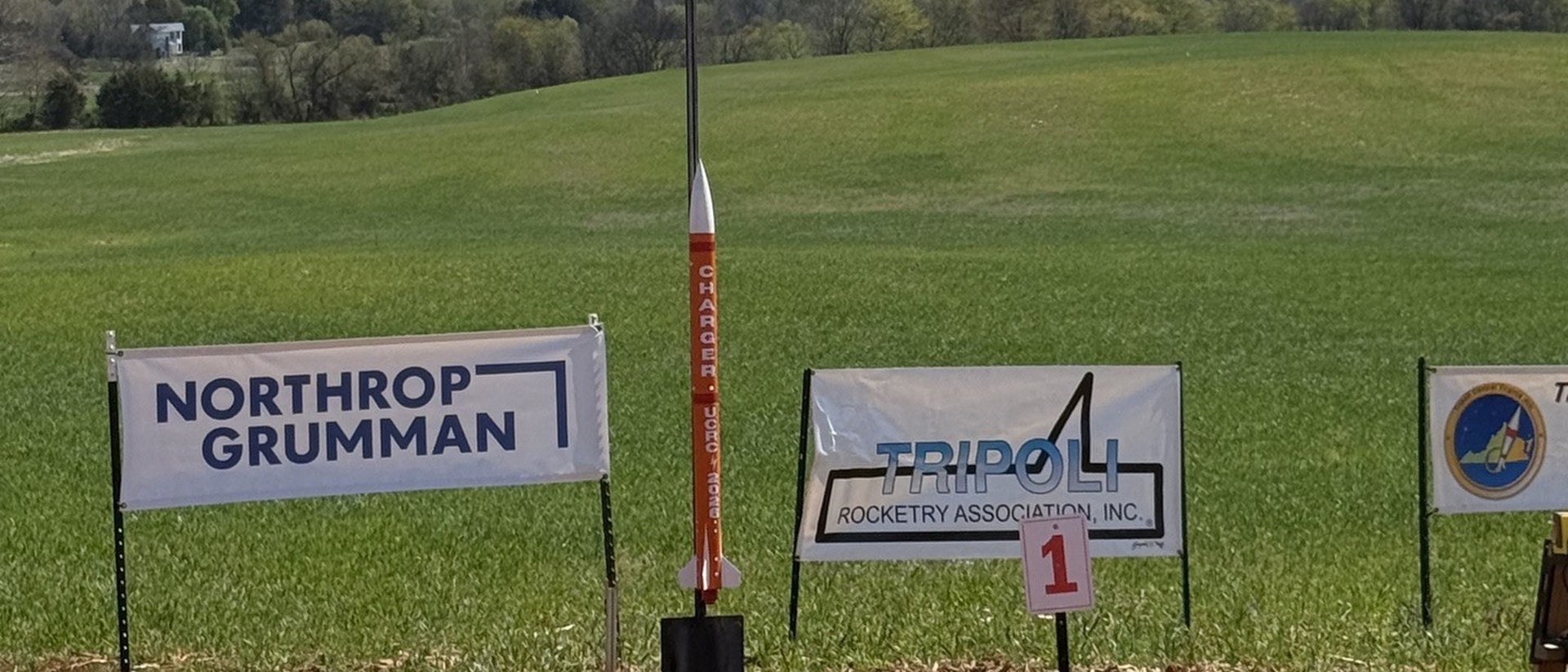
Three attempts per team, and the range closes at four in the afternoon. Weather can take the whole weekend, and if it does the awards are decided on the December and March review scores alone.
We got two clean flights away on the first day while the weather held, then put up the qualifying flight before noon on the second. One team member stands at the launch control officer's position as mission control and nothing leaves the pad until they say it does.
Final standings, published by Union College on 23 April 2026 and listed by the competition organizer.
Competition rules allow only team members to work on any part of the entry: design, simulation, build, repairs, launch. Advisers guide and mentors review, but nobody outside the team touches the rocket.
That put the recruiting and the funding on the same critical path as the airframe. The proposals paid for the hardware, the build labs produced twelve people who could fly it, and the two design reviews forced the team to write down exactly how the rocket worked before it flew.